Friday, June 8, 2018

Myconids - Everybody Else Has 'Em

Atavia - "What, is this the 5th project now?"

 Atavia is a mini-setting I'm making: condensing the most interesting parts of Age of the Ecclesiarchy (the thing with the Desolation in it) into a large island.

Atavia is divided into 4 baronies: Graam, in the top-left, Bös, in the top right, De Bahn to the right, and A'Tirae at the bottom.

Yeah, okay, great. What was that about myconids?

Fine. 

The top third of the map is the Motherland: an aboveground mushroom forest growing from the Mother Pillar, a 20-story tall fungus on the border of De Bahn and Bös. The area around the Mother Pillar is... unpleasant, let's say.

Myconids aren't very common in the Motherland: a sapient creature takes quite a lot of energy compared to something like a Shrieker. Because of the immense amount of material required to keep a Myconid alive, they aren't used for "menial" tasks, such as releasing spores: there are cheaper, easier fungi for that. Myconids are created specifically for communication: to be the pleasant, humanoid face of the inscrutable alien mind of the Motherland.


https://blazemalefica.deviantart.com/art/Myconids-519431194
There is one issue with that, however: brains take up a lot of energy, which the Myconids can't store easily. Because of this, Myconids have a tiny memory: a small amount of Common, how to walk, and how to use their arms. This means that asked basically any question at all, they tell the questioner to stay where they are, and run off, looking for a Commune.


Communes are memory stores for the Motherland: they can't move and can't speak, but are connected to the Motherland. When a Myconid needs the answer to a question, a Commune absorbs it, writes the answer into the Myconid's "flesh" and spits it back out.

Myconid's don't last long: the whole "having a brain thing" burns them out after a couple days.

Saturday, April 21, 2018

The Desolation, Part 2: The Elves

The Elves of the Desolation

Image Credit: Muglo
The elves of the Desolation work in a loose caste system, with the despicable common folk and disgusting foreigners at the bottom, and knowledgeable necromancers and noble council members at the top.

Elven cities are led by a Council, chosen through a convoluted system of nepotism, backstabbing, false elections, true elections, and then some more backstabbing for good measure. Members of the Council will either have a very short lifespan or an incredibly long one, depending on how well-protected they are.

Even outside of the Council, confusion, deception, and other such nonsense is commonplace. Because of this, even money must have a place in defending you. Instead of using gold, copper, or other metals, elves use Amulets of Shinnae, necromantic objects that contain souls. The Amulets of Shinnae are built by the noble necromancer caste, with souls taken from criminals, foreigners, and anybody an elven noble didn’t like very much. The Amulets inflict a geas on the soul, forcing them to protect their holder.

In case it wasn’t already easy to see, necromancy is far from taboo in elven society. The necromancer caste is one of the two noble castes, spending much of their time in their own towers, built by the other nobles.

Image Credit: Paizo, I think.
Necromancers are taught to replace most normal solutions to problems with urban living with their magic. Without easy sources of light, elven cities are lit with Soulamps: a fragment of a soul stored in a heavy, iron-bound lamp. When shattered, a Soulamp’s prisoner escapes with a deafening screech.

Elves are very isolationist, refusing to leave the Desolation. Some say they've found something, deep within.

The Desolation, Part 1: Creatures of the Desolation

The Desolation

The Desolation is an ice desert, comprised of tiny fragments of ice and sand and irradiated with horrible magics. With the rising sun, it becomes a hellscape of blinding light and wandering Prismwraiths. At night, the cold can crack even the most hardened adventures (if the creatures that awaken with the darkness don't first).

Cultivators

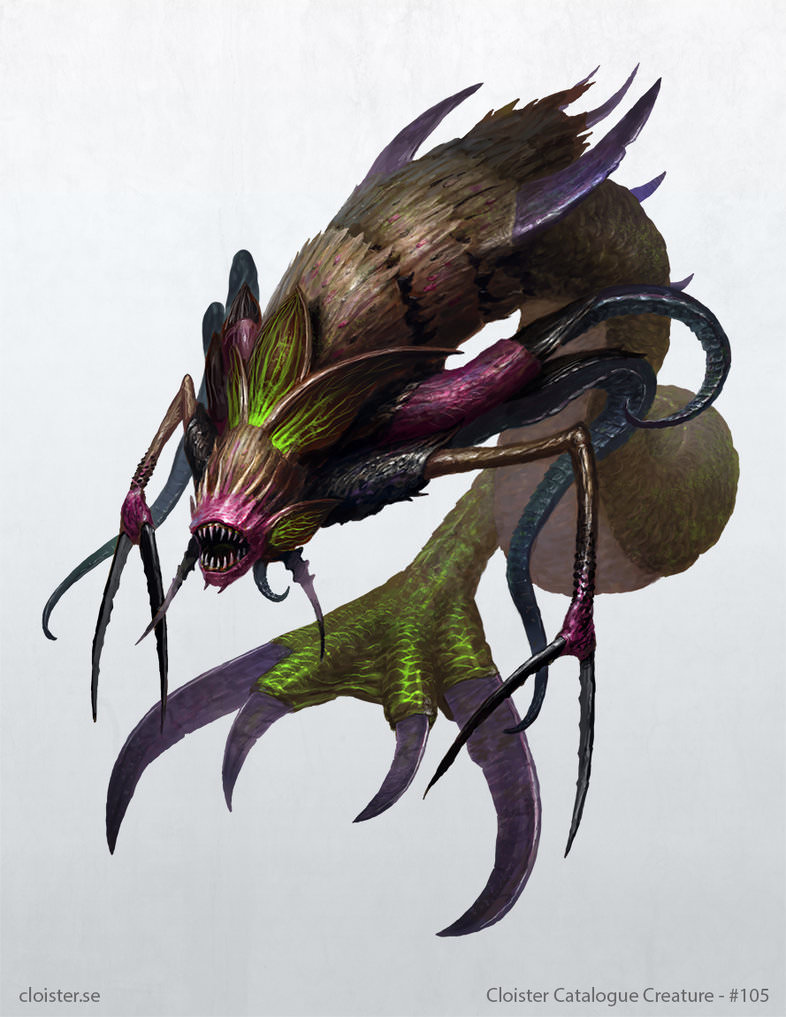
The Cultivators go through a metamorphic life, being born as small worm-like creatures and buried in some of the deeper chambers of their underground Hivecities. Decisions are made by the Queen's Circle, made up of the queens of every Hivecity.

The Cultivators are the only source of plants in the Desolation, and thus are often under attack by some creature or another, or under siege by the elves. To protect themselves, they fabricated the Wyrm Eaters, and military service is mandatory if a Hivecity comes under assault.

Cultivators worship the Inner Gods: ancient titans buried beneath the earth, revealed through fault lines. It is said some of the deepest Hivecities have burrowed all the way down to where the Inner Gods live. Cultivator clerics of Inner Gods such as Ursek, Ar-Torak, and Om-Tira are common in the larger Hivecities.

Image Credit: Cloister.se


Cultivator

Medium Monstrosity, Lawful Good

  • Armor Class 12 (Natural Armor)
  • Hit Points 10 (2d8)
  • Speed 30 ft., burrow 15 ft.

STRDEXCONINTWISCHA
10 (+0)8 (-1)12 (+1)14 (+2)14 (+2)6 (-3)

  • Senses Darkvision 120 ft., Passive Perception 12
  • Skills Arcana +2, Survival +2
  • Languages Cultivator
  • Challenge 1/2 (100 XP)
  • Damage Immunities Cold

Actions

Multiattack: The Cultivator can make 2 claw attacks
Claw: Melee Weapon Attack: +4 to hit, reach 5 ft., one target. Hit: 5 (1d8 + 1) slashing damage

Maidenfly


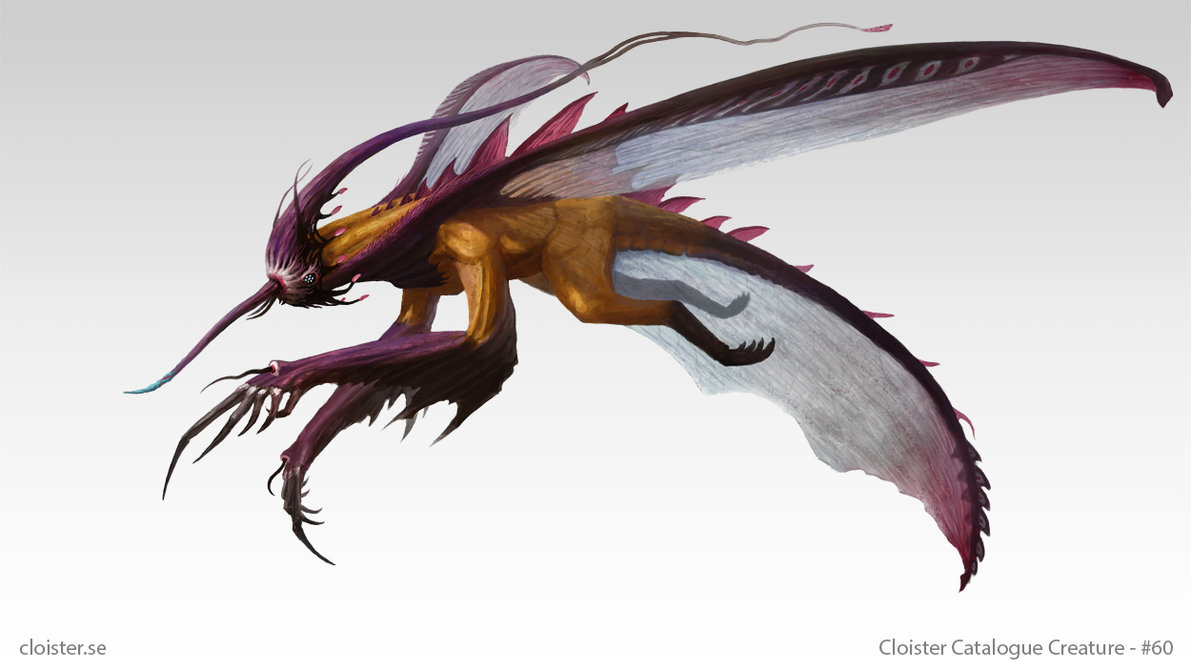
Maidenflies are bioengineered pollinators created by the Cultivators, with multiple pollen sacs, often filled with poisonous or irritating pollens, and their large proboscis, they can be somewhat dangerous, although they are very passive, and do not attack without a command from the Cultivators.

Image Credit: Cloister.se


Maidenfly

Tiny Monstrosity, Lawful Neutral

  • Armor Class 12
  • Hit Points 8
  • Speed 10 ft., fly 65 ft.

STRDEXCONINTWISCHA
6 (-2)14 (+2)10 (+0)3 (-4)14 (+2)5 (-3)

  • Senses Darkvision 20 ft., Passive Perception 11
  • Skills None
  • Languages -
  • Challenge 1/2 (100 XP)
  • Damage Immunities Cold

Actions

Jab: 1d4 piercing damage, +2 to hit, 5 ft. reach, one target
Stunning Pollen: All creatures other than Maidenflies, Cultivators, and Wyrm Eaters in a 30 foot dome around the Maidenfly must make a DC 5 constitution save or be stunned for two turns.
Irritating Pollen: All creatures other than Maidenflies, Cultivators, and Wyrm Eaters in a 30 foot dome around the Maidenfly must make a DC 10 constitution save or have disadvantage on to hit rolls as well as attackers having advantage on affected targets for the next 3 turns.
Vitalizing Pollen: All Maidenflies, Cultivators, and Wyrm Eaters within a 30 foot dome around the Maidenfly gain +10 ft. of movement, +1 to hit rolls, and 5 temporary hit points.

Prismwraith

Prismwraiths are formed by the reflected light of the Desolation reacting with the magical radiation contained within. They spend their single day wandering, with their fragmented minds racing to understand what they are. Large amounts of them congregate to Elven cities, where they can find the light they need to survive.

Prismwraiths are not always immediately aggressive, but often lash out in confusion. They vanish at sunset, with the loss of the light that makes them up.


Prismwraith

Medium Celestial, Chaotic Evil

  • Armor Class 14
  • Hit Points 65
  • Speed 0 ft., fly 80 ft., (hover)

STRDEXCONINTWISCHA
6 (-2)16 (+3)16 (+3)12 (+1)14 (+2)5 (-3)

  • Senses Passive Perception 16
  • Skills None
  • Languages -
  • Challenge 5 (1,800 XP)
  • Damage Resistances acid, fire, lightning, thunder; bludgeoning, piercing, and slashing from nonmagical attacks that aren't silvered
  • Damage Immunities necrotic, poison, cold, radiant
  • Condition Immunities charmed, exhaustion, grappled, paralyzed, petrified, poisoned, prone, restrained
  • Incorporeal Movement: The wraith can move through other creatures and objects as if they were difficult terrain. It takes 5 (1d10) force damage if it ends its turn inside an object.
  • Solar Powered: The Prismwraith disappears if not touched by sunlight.

Actions

Radiant Cone: 2d10 radiant damage, 15 ft. cone
Radiant Beam: 2d8 radiant damage, 75 ft. range, one target

Wyrm Eater

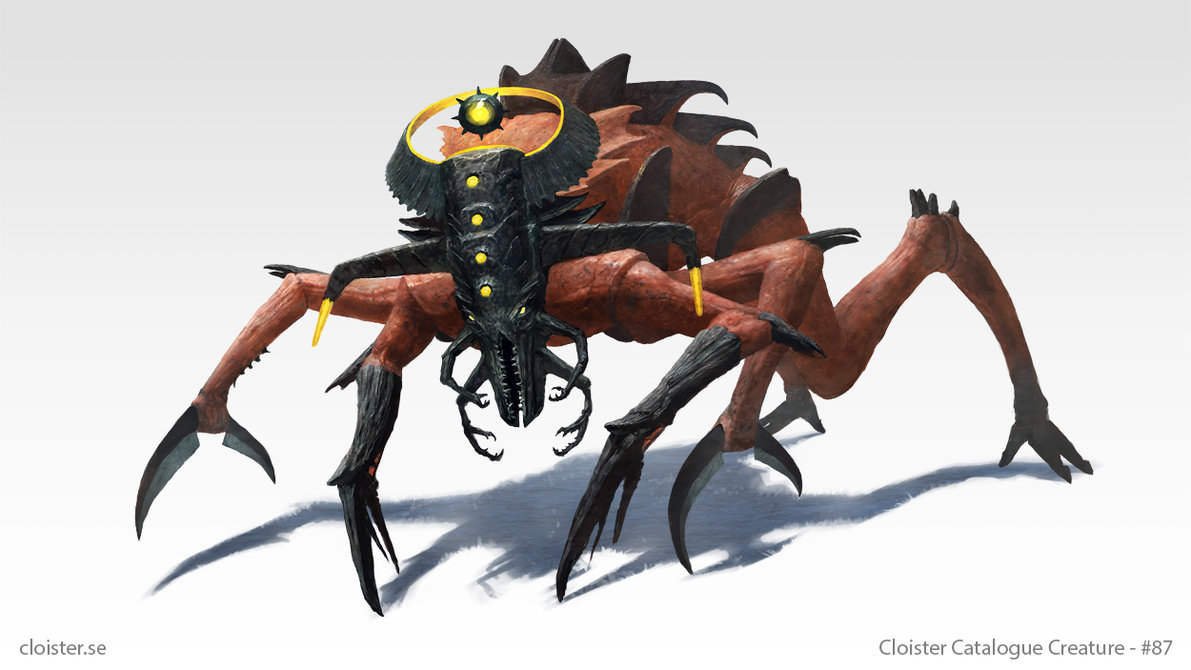
Wyrm Eaters are bred and kept by the Cultivators for use as protectors. Their circular antennae connect them to the energies of magic, and their large size and destructive mandibles make them formidable opponents in close combat.

Wyrm Eaters fight quickly and violently, but each has been trained to minimize collateral damage.

Image Credit: Cloister.se


Wyrm Eater

Medium Monstrosity, Lawful Neutral

  • Armor Class 18
  • Hit Points 37
  • Speed 30 ft.

STRDEXCONINTWISCHA
15 (+2)10 (+0)14 (+2)11 (+1)12 (+1)6 (-3)

  • Senses Darkvision 60 ft., Passive Perception 16
  • Skills None
  • Languages -
  • Challenge 2 (450 XP)
  • Damage Immunities Cold
  • Charge If the Wyrm Eater moves at least 30 ft. straight toward a target and then hits it with a Slam attack on the same turn, the target takes an extra 3d6 bludgeoning damage.

Actions

Slam: 1d10 bludgeoning damage, +2 to hit, 5 ft. reach, one target
Kinetic Blast: 1d8 force damage, 100 ft. range, one target
Acid Spray (Recharge 4-5-6): Deals 2d6 acid damage in a 30 ft. line, 5 ft. wide
Kinetic Storm (Recharge 5-6) Fires 4 blasts, each dealing 1d8 force damage with a range of 100 ft. You can direct the blasts at the same target or at different ones. Make a separate to hit roll and attack roll for each blast.

Silentwyrm

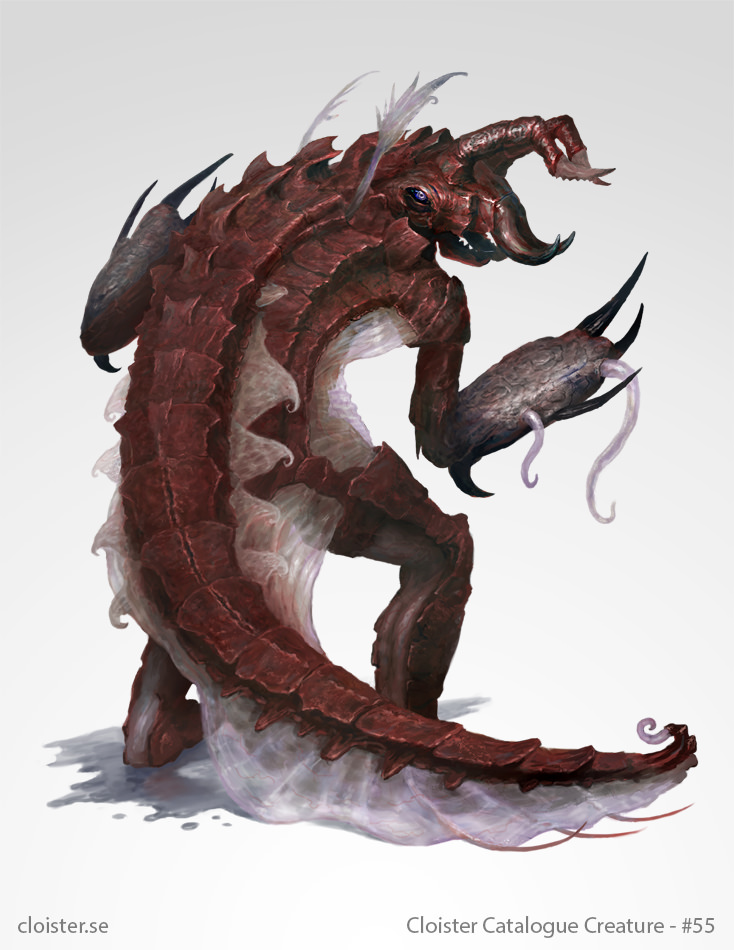
Silentwyrms burrow under Cultivator farms, hiding their heads by folding the leafy flaps behind their head over their titanic maw, waiting for a Cultivator to come by. Silentwyrms will focus on killing or knocking one person unconscious, then dragging them away.

Even if their camouflage is broken, Silentwyrms are big, violent, and destructive: perfect for DMs to use against players who think there's nothing to be afraid of in the Hivecities.

Image Credit: Cloister.se


Silentwyrm

Large Monstrosity, unaligned

  • Armor Class 18
  • Hit Points 154
  • Speed 30 ft., burrow 30 ft.

STRDEXCONINTWISCHA
18 (+4)8 (-1)18 (+4)11 (+1)12 (+1)6 (-3)

  • Senses Darkvision 120 ft., Blindsight 120 ft., Passive Perception 16
  • Skills None
  • Languages -
  • Challenge 8 (3,900 XP)
  • Damage Immunities Cold

Actions

Multiattack: The Silentwyrm makes 2 Claw attacks.
Bite: 1d10 bludgeoning damage, 1d6 piercing damage +3 to hit, 30 ft. reach, one target, then attempts to grapple.
Consume: The Silentwyrm makes one bite attack against a Medium or smaller creature it is grappling. If the attack hits, that creature takes the bite's damage and is swallowed, and the grapple ends. While swallowed, the creature is blinded and restrained, it has total cover against attacks and other effects outside the Silentwyrm, and it takes 21 (6d6) acid damage at the start of each of the Silentwyrm's turns. If the Silentwyrm takes 30 damage or more on a single turn from a creature inside it, the Silentwyrm must succeed on a DC 15 Constitution saving throw at the end of that turn or regurgitate all swallowed creatures, which fall prone in a space within 10 feet of the Silentwyrm. If the Silentwyrm dies, a swallowed creature is no longer restrained by it and can escape from the corpse using 15 feet of movement, exiting prone.
Claw: 2d10 slashing damage, +5 to hit, 60 ft. reach, one target

Saturday, April 14, 2018

Will Work For Copper: Celebrants of the Dragon Emperor

Celebrants of the Dragon Emperor

Will Work For Copper is a comedic d6-based RPG I'm writing where the player characters are apprentice wizards, random people, petty thieves, and generally incompetent. Lucky for them, so are the enemies: the endless Kobold hordes of the Dragon Emperor.

The Celebrants are the Dragon Emperor's lieutenants, and each leads an army of kobolds. Each of them hates the rest. They will never cooperate without the Dragon Emperor's forceful interference.

Perfected-Wind

Image Credit: Hunqwert


The air dragon Perfected-Wind is overly dramatic and theatrical. She thinks even the lightest wound could kill her, and reacts accordingly. Her kobolds are very quick-thinking: a necessary trait to quickly convince Perfected-Wind of her continued health.

Scattered-Lights

Image Credit: WOTC
Scattered-Lights is not a dragon. His predecessor, Tattered-Sky, died under mysterious circumstances. A few days later, Scattered-Lights took control of Tattered-Sky's soldiers and equipment. The issue with this is that Scattered-Lights is actually a paper puppet with 5 kobolds in it. The five kobolds switch around leadership every week, making Scattered-Lights seem confused and strange when it comes to strategy.

Scattered-Lights' kobolds know their leader is a puppet, and have gotten used to the strange, conflicting orders by only listening to the largest swathes and concepts, making it easier to change plans at a moment's notice.

Bloodied-Tide


Image Credit: Creature Caster
Bloodied-Tide is a water dragon, and also a zombie. He still has authority, for some reason, although he mostly uses that to wander around moaning "BRAINSSSS" at people. His kobolds have a rather higher ratio of necromancers than most: they spend their time studying Bloodied-Tide, in the hope of learning how he was returned to life.

Bloodied-Tide's army is led by a kobold wizard named Watches-Sunlight. However, Watches-Sunlight is just as incompetent as any other kobold. While she thinks her leadership is a secret, it's common knowledge.

Sundered-Mountain

Image Credit: Athayar
The earth dragon Sundered-Mountain is the youngest of the Celebrants, and thinks she's much smarter than he actually is. Her kobolds spend most of their time building overcomplicated Rube Goldberg devices, for use as traps. Sundered-Mountain rarely leaves her lair, where she constantly improves her defenses.

Sunday, March 18, 2018

The Iyr, Part 1

The Iyr
The Iyr appear through gates torn through the fabric of the dimensions, clawing for territory in the Prime Material Plane (or equivalent). Their invasions are led by a Priemarchos, based on limited translation of their language, but nothing is known of their leadership above that level: the gates last for too short a time for exploration at this time.
Iyr Prielia
Iyr Prielia are the frontline fighters of the Iyr invasions, bound in translucent, whitish crystal armor, and armed with Sunslivers or Psychespears. They fight by taking advantage of their mobility, and avoid use of static defenses.

Iyr Prielia
Medium Outsider

Armor Class: 17
Hit Points: 12
Speed: fly 35 ft., walk 35 ft.

STR: 13
DEX: 12
CON: 12
INT: 11
WIS: 10
CHA: 10

Skills: Athletics +2, Acrobatics +2
Damage Vulnerabilities: Bludgeoning
Damage Immunities: Psychic, Poison
Condition Immunities: Poison, Exhaustion, Charmed
Senses: Passive Perception 13
Languages: Iyrn
Challenge: 1/4 (50 XP)

Iyr Orincepsis 

The Orincepsis are gifted with nightmarish psionic powers, running through the conductive crystal of their disproportional heads. Instead of purely destructive abilities, their mental abilities manifest through manipulation, confusion, and control. They are sent out as infiltrators, in the first wave of an invasion. However, because of the short time they can disguise themselves, they are often reclusive, and act strangely.

Iyr Orincepsis
Medium Outsider

Armor Class: 14
Hit Points: 35
Speed: fly (hover) 35 ft. when undisguised, 20 ft. when disguised

STR: 10 
DEX: 8
CON: 9
INT: 13
WIS: 17
CHA: 13

Skills: Bluff +4
Damage Vulnerabilities: Bludgeoning
Damage Immunities: Psychic, Poison 
Condition Immunities: Poison, Exhaustion, Charmed
Senses: Passive Perception 13  
Languages: Iyrn, one other (depending on specifics of mission: generally Common)
Challenge: 2 (450 XP)
Innate Spellcasting: Once a day, the Orincepsis can cast Dominate Person as a 6th Level spell. Eight times a day, the Orincepsis can cast Disguise Self. Its innate spellcasting ability is Wisdom.

Actions
Thrash: (Melee Weapon Attack) +6 to hit, reach 5 ft., one target. Hit: (1d10 + 2) piercing damage.

Weapons
Sunsliver
The Sunslivers are glass, tube-shaped shortswords built by the Iyr. When activated, the tube fills with a bar of solidified sunlight.

Credit: Blask22

Damage:
1d6 Burning
Weight: 2 lb.
Properties: Finesse, Light
Burning Light: Once a day, the Sunsliver's light can burst out from its casing in a hellishly bright flash, dealing 1d6 Radiant damage in a 15 foot cone.

Psychespear
Psychespears are short glass spears tipped with a hole in space. While it isn't large enough to cause physical harm, the mind recoils from its touch, and it bends attempts at scrying.

Credit: Algadon
Damage: 1d6 Psychic
Weight: 2 lb.
Properties: Thrown (20/60) 
Scrybending: Attempting to scry someone holding a Psychespear, there is a 25% chance of failure.

Shinegun
Shineguns work off the same process as Sunslivers, binding sunlight into glass. When triggered, the weapon releases the light in a burning beam. They also have a secondary mode, which erases every charge, dumping all of them into a single, apocalyptic blast.


Damage: 1d6 Burning
Weight: 1 lb.
Properties: Ranged (50/120), Ammunition (can hold a maximum of 25 charges, each shot taking 1.)  
Solar: Gains 1 charge every hour left in sunlight.
Secondary Fire: Fires a projectile that deals 1 damage per remaining charge, and uses every remaining charge.

Sunday, February 11, 2018

Kill the Goblins: The Deia

The Deia are a replacement for goblins, built for 5e D&D. They build upwards, in tight clusters of lofty towers, ruled by tight-knit, apathetic houses. Oh, and also they're poisonous. Forgot about that bit.

They can be found here.

Friday, January 26, 2018

Ecology of the Derelicts (Sunless Horizon)

The Derelicts
The Derelicts are the core of Sunless Horizon. Broken, floating fragments of starships, they make the only resources available to the remnants of humanity. Each is filled with disintegrating components, volatile chemicals, and violent synthetics.

However, some things still manage to eke out a living in this lightless expanse.

Reactor Moss
Gathering energy from the barely-active nuclear materials inside of a derelict's reactor and food from any creature that steps into them, Reactor Moss grows as wide grey beds with hundreds of hooks, waving as if to wind until something comes within reach. When an organic creature comes within reach of the hooks, they grab it, draining the nutrients from the creature to replace what would have been gained from soil.

Reactor Moss reproduces using sticky, hardened spores that hibernate until reaching a survivable surface: generally another derelict.

Spitting Lily
The Spitting Lily is a rarer specimen, only growing on derelicts with available chemical stores. The Spitting Lily synthesizes those chemicals into a vicious acid it spouts at prey. Spitting Lilies have a wide, bulbous stem which tapers into a narrow hose, surrounded by acid-resistant petals.

Orion's Eye
The Orion's Eye is a more proactive predatory plant, rolling through the hallways of derelicts like an angry tumbleweed. Each of their springy branches end in spheres of sticky acid: while the adhesive is weak enough to allow the Eye to move, it's strong enough to catch insects out of the air. Unlike the Spitting Lily or Reactor Moss, the Orion's Eye is nothing more than an inconvenience to scavengers.

Bristlebeast
The horse-sized furred Bristlebeast is common on derelicts with Reactor Moss. Their face's brush-like set of bristles are vibrated by thousands of tiny muscles to scrub Reactor Moss off of its walls, to be picked up by the Bristlebeast's five barbed tongues. They have a disproportionately long, thick neck, in order to avoid bringing the body too close to Reactor Moss, and hopefully pull the head out in case of accidental contact.

Bristlebeasts are skittish, preferring to avoid combat, and cannot survive in space.


Sledgehammer Crab (this is a terrible name.)
The predatory Sledgehammer Crab secretes a sticky material and uses its claws to scrape metal off of the sides of derelict hallways to attach them to itself.

The Borer Fly drills into the shells they create, living off of small pieces of the crab. When their "nest" is attacked, they swarm out to defend it.
 

Borer Fly
The feathered Borer Fly has more in common with birds than insects, with a large, spiked beak to drill into Sledgehammer Crabs and through the walls of derelicts. They only fight if their living nest is under threat, returning to it when the threat is gone.

Nipper Fly
The Nipper Fly is an herbivorous insect with a conspicuously large set of mandibles, similar to a stag beetle. Similar to the Borer Fly, the Nipper Fly is covered in a layer of gray feathers. They eat plants, such as the Spitting Lily, by latching onto them and tearing pieces off through violent spins.


Harpoon Fly
The Harpoon Fly's most recognizable feature is its large, barbed stinger. While it is not poisonous, it is between 6 and 12 inches long, making up almost three quarters of the Harpoon Fly's body length. The barbed stinger is used to impale Borer Flies after they drilled into Sledgehammer Crabs. Because of the stinger's length, the Harpoon Flies have difficulty flying, commonly staying on the same crab for days at a time.


Morningstar Crab (also a terrible name)
The herbivorous Morningstar Crab, an evolutionary relative to the Sledgehammer Crab, eschews the sticky excretion and shell for a covering of spiny hairs. It burrows through metal, waiting for more violent creatures to pass before leaving to eat.

Sunless Horizon Beta 2.3 Release

Commissioned from Scrap Princess excited screeching I've been posting about  Sunless Horizon  for about a year, and after finally gettin...