Monday, April 22, 2019

Review Some GLOG-likes? Why Not? (Rat on a Stick, Owlbear Stew, Moonhop, DIE TRYING)

The GLOG is strange, when compared to other OSR systems: while best known for its levelless magic system, its easy multiclassing and utterly ridiculous amount of classes give it a high focus on character building (for an OSR system, at least). Despite this, it is one of the most active parts of the OSR community. And whenever there's an audience, there's hacks. It seems like everyone who writes about the GLOG for long enough puts together some new version (including me cough cough), giving us a simple question: which of these are the best (according to some guy who wouldn't know an RPG if you hit him with it a couple years ago).


Rat on a Stick

To many people, Skerples' Rat on a Stick is the original GLOG: the first thing to rise from Goblin Punch's weird primordial game-soup.

Overview
  • Roll-under System
  • Standard Stats + Secondaries (Attack, Defense, Movement, Stealth)
  • 4-template classes
  • Roll under your attack + (10 - the target's defense) to hit
  • 1d50 race table of mostly animal-lings, each with 1 advantage and 1 disadvantage
  • Feudalistic Setting
The Actual Review Part of This Nonsense
Rat on a Stick's main problem is the combat system: instead of a faster d20 against AC, it has math, the bane of my existence. Rolling under a stat + (10 - another stat) for each attack is cumbersome and hard to explain.

The race table is one of the best parts of the system, and easily pulled out and used in a different hack.

I rate Rat on a Stick 3/5


Owlbear Stew

Owlbear Stew, created by Meandering Banter, is a good example of what I think of as a second-generation hack (because I'm pretentious): it obviously shares most of its words-DNA with Rat on a Stick, but adds new secondary rules and character creation options.

Overview
  •  Roll-under System
  • Standard Stats + Secondaries (Melee, Ranged, Defense)
  • 4-template classes
  • 2d8 race table of traditional races
  • No actual combat rules - just unexplained stats (melee, ranged, defense)
  • Gambits - have something worse happen on a miss to do something good on a hit
  • Many extra and optional rules: diseases, mindsets (situational bonuses, such as Angry - reroll a failed initiative check if you immediately charge), trauma and mental breakdowns, karma (dying in a good way and doing good deeds gives you a bonus for your next character)
  • Many more classes, some even having subclasses
The Actual Review Part of This Nonsense
Owlbear Stew is less like stew and more like a box of (sometimes exploding) chocolate: it's less a complete system, and more a load of mechanics to take things from.


If you plan to take mechanics, I'd recommend Mindsets: if you give them to your players at character creation, they're a really easy way to add some character differentiation (along with a small personality trait). Gambits are also very common in later GLOG hacks.

I rate Owlbear Stew 2/5


Moonhop

To be honest, I'm not sure if this is more of a GLOG hack or an ItO hack. Either way, it is a very interesting game, with mechanics far from more conventional GLOG hacks.

Overview
  • Roll-under System
  • 3 stats - STR, DEX, CHA
  • No classes - combination of a branching race table and branching background table
  • Initiative is a DEX check: players roll one every turn
  • Attacks always hit, Gambits based off STR checks
  • GLOG magic system based around components
The Actual Review Part of This Nonsense
Moonhop is probably the easiest of these hacks to run at the table: between its short size and easy character creation, players can read it and prepare for the game in minutes. The backgrounds also show a strange setting, with options from medieval squires to starship engineers.

Unlike Owlbear Stew, Moonhop has few extra rules that could be taken - this helps the book be half the length, despite its large text.

I rate Moonhop 4/5


DIE TRYING

DIE TRYING is a 2nd edition of Owlbear Stew, with an expansive classless character creation system.

Overview
  •  Roll-under System
  • Standard Stats + Secondaries (Melee, Ranged, Defense)
  • 2d8 race table of traditional races
  • More organized than Owlbear Stew
  • No classes: roll 3 times on a nested 2d20 table
  • Less extra rules than Owlbear Stew
The Actual Review Part of This Nonsense
DIE TRYING has one of the longest, most complex character creation system in any OSR game I've ever seen. While many people will certainly have a problem with this, I find it excellent. Outside of that, it stays very similar to Owlbear Stew.

The improved organization when compared to Owlbear Stew is very noticeable. As well as the better organization, it's also 10 pages shorter than Owlbear Stew. This does remove many of the interesting extra rules found in Owlbear Stew, but they can easily be picked out of that game and placed in DIE TRYING. (I also like it's name the most.)

I rate DIE TRYING 4/5

Wednesday, April 17, 2019

The Peasant Gods of Sunless Horizon

Note (7/31/2020): This post has been replaced. Read this instead.

Many of the commoners of the Navigator Houses believe in the 3 Peasant Gods, and keep small shrines to them in their homes.

The nobility have their own gods. You may not speak to them.

Capra, Devourer

Capra did not speak as he consumed the fire. It was not his place to complain.
  • Appears as a goat-headed man in rags.
  • Represents stoicism, and the ability to handle changing situations.

Guardian Ursus

From his blood his lord fed.
  • Appears as a tall armored man bearing only a shield.
  • Represents sacrifice for your superiors.

Vulpes, Who Watches 

And Vulpes appeared in front of his lord, and spoke of the crimes of the people. For this, he was rewarded.
  • Appears as a 3-eyed white fox.
  • Represents surveillance, foresight, and reporting crime to your superiors.

Tuesday, April 16, 2019

Wormgod's Harvest Part 3: Weapons & Equipment

Wormgod's Harvest is a biotech fantasy setting where the Wormgod consumed the world.

Bladebugs

Bladebugs are throwing weapons that fly nimbly towards targets before slicing through them with their sharp exoskeletons. They barely do any damage because of their small size, but they never miss, and can be thrown in groups of 3 at once.

Militaries grow special breeds of Bladebugs that release acid or explode on impact. For fire support, they carry large hives filled with hundreds of Bladebugs that are released dozens at a time.

Smokers 

Smokers are a variety of flying squid bred and Shaped for lessened flight ability and larger ink sacs. When hit hard, they panic, filling the air with ink. Small Smokers are thrown to create smokescreens in ground conflict, and larger ones are launched from bioships to blind opposing vessels. 
 

Knifelizard

Knifelizards are small reptiles with bladed tails: when pressure is applied to their sides, they straighten out and stiffen.

Ansibles

Ansibles are frog-like emergency comm systems usually attached to bioships: when fed a colored pellet, they send an ultrasonic message based on the pellet given. While the Ansibles are the fastest way to communicate over long distances, they can only send a few types of messages.

Messenger Bird

Messenger Birds are an alternative to Ansibles: while they are slower, they can send more complex message. They memorize things they hear and repeat them to the target of their message.

Friday, April 5, 2019

Infra-Red Rewrite: History

hey infra-red wasn't very good
i started over
i guess this is also a sample page for the book
oh yeah this is going to be a book
 

Tuesday, April 2, 2019

Weapons of Sunless Horizon

Is everyone tired of Sunless Horizon yet?

Weapons in Sunless Horizon are (simply to help me organize them) set into 4 groups: Cheap, which are smashed together out of hull plating and wiring, Decent, which are actual guns put together by people who know how to make guns, Expensive, for the nobility and their guards, and Artifacts built by the original owners of Ein Soph. Artifacts cannot be purchased.

Cheap

Melee - Club 

It's a stick. You hit people with it.

Ranged - Cangun

Canguns are empty cans filled with an explosive charge, then nails or shrapnel before being resealed and attached to a stick. When the charge is detonated, it creates a horrific wave of red-hot metal, tearing through everything in front of the wielder.

Of course, the problems with this weapon should be obvious. While it's shockingly destructive even against Disciples, the shrapnel doesn't always go in the right direction.

Decent

Melee - Talon & Fang

Used to kill Disciples, Talon & Fang is a combination of 2 weapons: the talon, a short crowbar-like prying tool, and the fang, a thin serrated knife.

The talon is used to pull at the casings of Disciples to reveal internal components and wiring, which is cut with the fang.

Ranged - C50 Tessen

Circlet Security's belt-fed C50 Tessen submachine gun fires 7mm rounds at a slow rate of fire. The Tessen's belt feed makes it excellent for sustained fire, and its small caliber makes it easy to control.
Circlet Security's weapons are made from yellowed, brittle plastic and thin stamped metal. Stories abound of them fracturing or shattering when dropped, or shaking apart from the force of their underpowered rounds. Despite this, Circlet Security surplus is common among scavengers.

Expensive

Melee -The Long Hand

The weapons of the nobility are strange, focusing more on appearances than true effectiveness. The Long Hand is a intricately carved metal club on a long rope, swung in long loops before striking with gathered inertia.

The long wire is used to subtly manipulate the head, making it more difficult to block. It can also be used to entangle other weapons.

Ranged - Ashford & Crane Temperance

Ashford & Crane is the oldest weapon designer on Ein Soph, responsible for the weapons of the nobility. The Temperance is a large heavy rifle, loaded with the highest-quality powder and explosive shells.

Friday, March 29, 2019

Engine Heart: Repairbot Playbook

blah blah d10-based RPG about service robots, download here, previous playbook here.

Engine Heart: Repairbot

Who Built Your Processor? (1d4)

1. Hansa Automation - 3 RealityCom, 2 HumanCom, 2 DigiCon, 2 MechaniCon, 2 Buffer

2. Parable Intelligence - 1 RealityCom, 1 HumanCom, 4 DigiCon, 4 MechaniCon, 1 Buffer

3. Padlock Reinforced Processing - 2 RealityCom, 1 HumanCom, 1 DigiCon, 1 MechaniCon, 4 Buffer

4. ASQ Social Systems - 2 RealityCom, 4 HumanCom, 1 DigiCon, 1 MechaniCon, 1 Buffer


Who Built Your Chassis? (1d6)

1-2. Ducharme Optics - 2 Dexterity, 2 Mobility, 4 Perception, 2 Reflexes, 2 Strength

3-4. Yosef Industrial - 1 Dexterity, 1 Mobility, 2 Perception, 1 Reflexes, 5 Strength

5-6. EOM Advanced Motors - 3 Dexterity, 3 Mobility, 2 Perception, 3 Reflexes, 1 Strength


Major Feature (1d10)

1. Abrader

2. Attendant Swarm

3. Cutting Laser

4. Manipulative Limb (Standard)

5-10. Plasma Arc Welder


 Minor Feature (Roll 1d12 Twice, Take Both)

1. External Container

2. Display Screen


3. Electromagnet

4. Flexible Body

5. Jack

6. Power Dock

7. Rack

8. Specialty Chassis

9. Simple Assembly

10. Tool Set

11. Telescoping Reach

12. Winch


Defects (Roll 1d8 Twice, Take Both)

1. Manual Feature

2. Conspicuous

3. Exposed Power Switch

4. Mute

5. Plastic Casing

6. Simple Programming

7. Top-Heavy

8. Response Lag

Advanced Skeleton-ing

why did i write this

Welcome to Richard's Half-Price Necropolis

All the Skeleton, Half the... uh. 

hooray...
 Here at Richard's, we milk bad jokes for all they're worth have everything for your skeleton-based needs!

Think skeletons are just too stupid on their own? We sell Psionic Skeletons - 100% organic Illithid brain-paste stuck to the inside of the skull for maximum effectiveness! Make your enemies marvel at the inefficiency of raising a brainless form only to put another brain in it!

The main advantage of skeletons is the cargo space! Beehive Skeletons make the most of it by wedging angry bees into the ribcage, for excellent area denial!

All this sounding too natural? Move up the tech-tree a bit to whatever-punk with Flamethrower Skeletons! Use up all that empty space with volatile fuel tanks! Even in death they burn with anger! (and also fire).

Don't want fire around your houseplants? Try Electric Skeletons - wires connected to the arms and legs make each attack shockingly powerful!

HARNESS THE POWER
make it stop

That was amazingly bad. As penance, have some stats for the utter nonsense I've created.

Exceptionally Average Skeleton
HD: 1
AC: 10

Attacks
Whack: 1d6 damage
Arm Throw: 1d4 damage + Grapple

Psionic Skeleton
HD: 1
AC: 10

Telekinetic Field: Arrows are at -2 to hit. Missed arrows are redirected at the Psionic Skeleton's enemies.

Attacks
Whack: 1d6 damage
Telekinetic Shove: A human-sized target within 50' is thrown backwards 30', taking 1d4 damage per 10' traveled. Throwing a creature at another target requires the Psionic Skeleton to make a successful attack roll against the target of the throw. If the roll is successful, both characters take 1d6 damage per 10' of travel. 1/day


Beehive Skeleton 
HD: 1
AC: 10

Eyes of the Swarm: The Beehive Skeleton sees through the eyes of its bees. 

Attacks
Whack: 1d6 damage
BEES: Bees swarm around your head, blinding you.
The Hive: The Beehive Skeleton tears out its beehive and throws it up to 30'. A 10' radius around the hive is filled with enraged bees, blinding and dealing 1d4 damage per turn to everyone inside the radius. They relax after 1d6 turns.

Flamethrower Skeleton
HD: 1
AC: 12

Volatile: If critically hit, the Flamethrower Skeleton explodes (as Fireball).

Attacks
Whack: 1d6 damage
Flamethrower: As Burning Hands

Electric Skeleton
HD: 1
AC: 13

Conduction: Melee attacks against the Electric Skeleton conduct electricity into the attacker, dealing 1d4 damage.

Attacks  
Electric Whack: 1d8 damage, CON save or stun
Whip: 1d4 damage, CON save or stun, ranged

Thursday, March 28, 2019

Wormgod's Harvest, Part 2: Society

hey none of this makes sense without reading the first one so you should do that ok thanks 

Bös

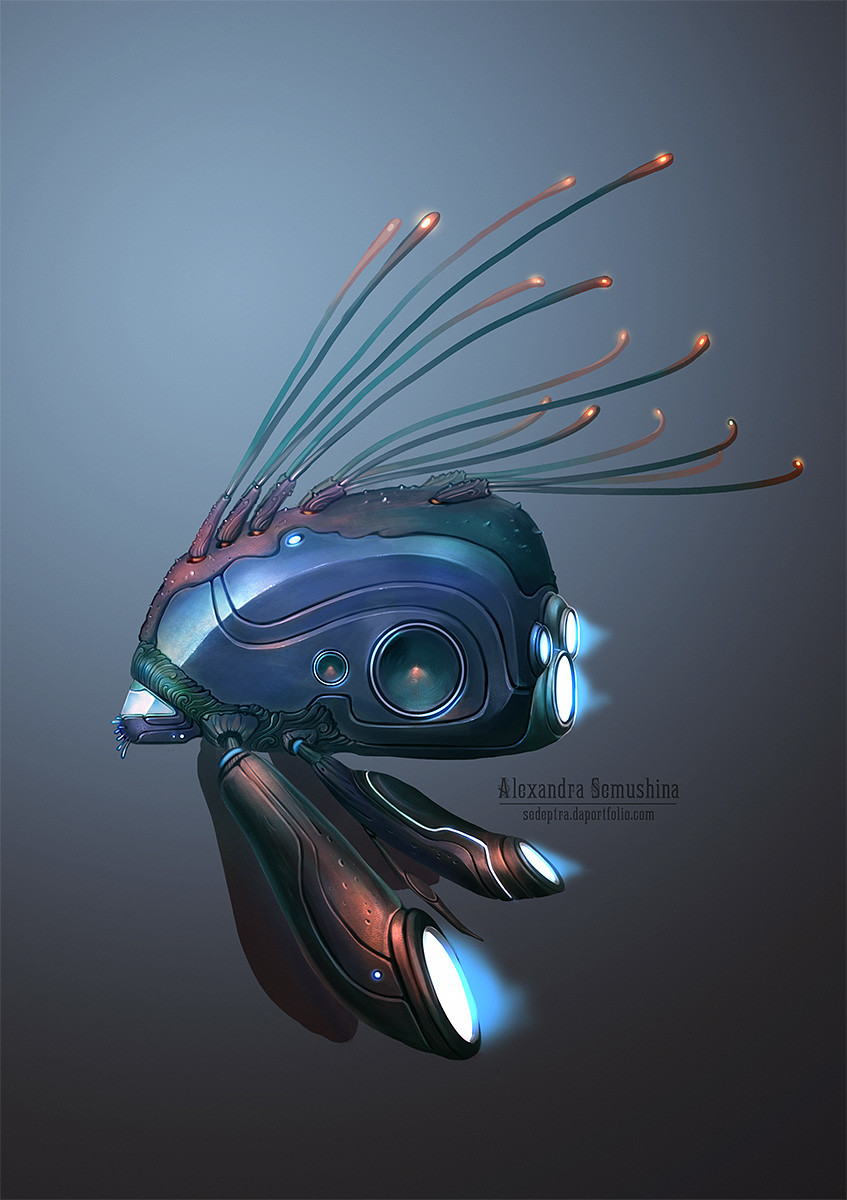
The capital of Bös is set on the largest island orbiting the Wormgod; this large, single landmass also has the largest mineral deposits, giving Bös the largest military presence, as the metals can be used to support advanced Shapings.

The large military of Bös belies its peaceful nature; Bös hasn't been involved in a conflict since the Collapse of the Spire, about 40 years ago.

The state religion of Bös sees the Wormgod as the harbinger of a new reality: it will kill everything, and through that death we will ascend to heaven. The lower-class people of Bös disagree, saying the government holds this stance to wipe away the ethical questions of their autocracy.

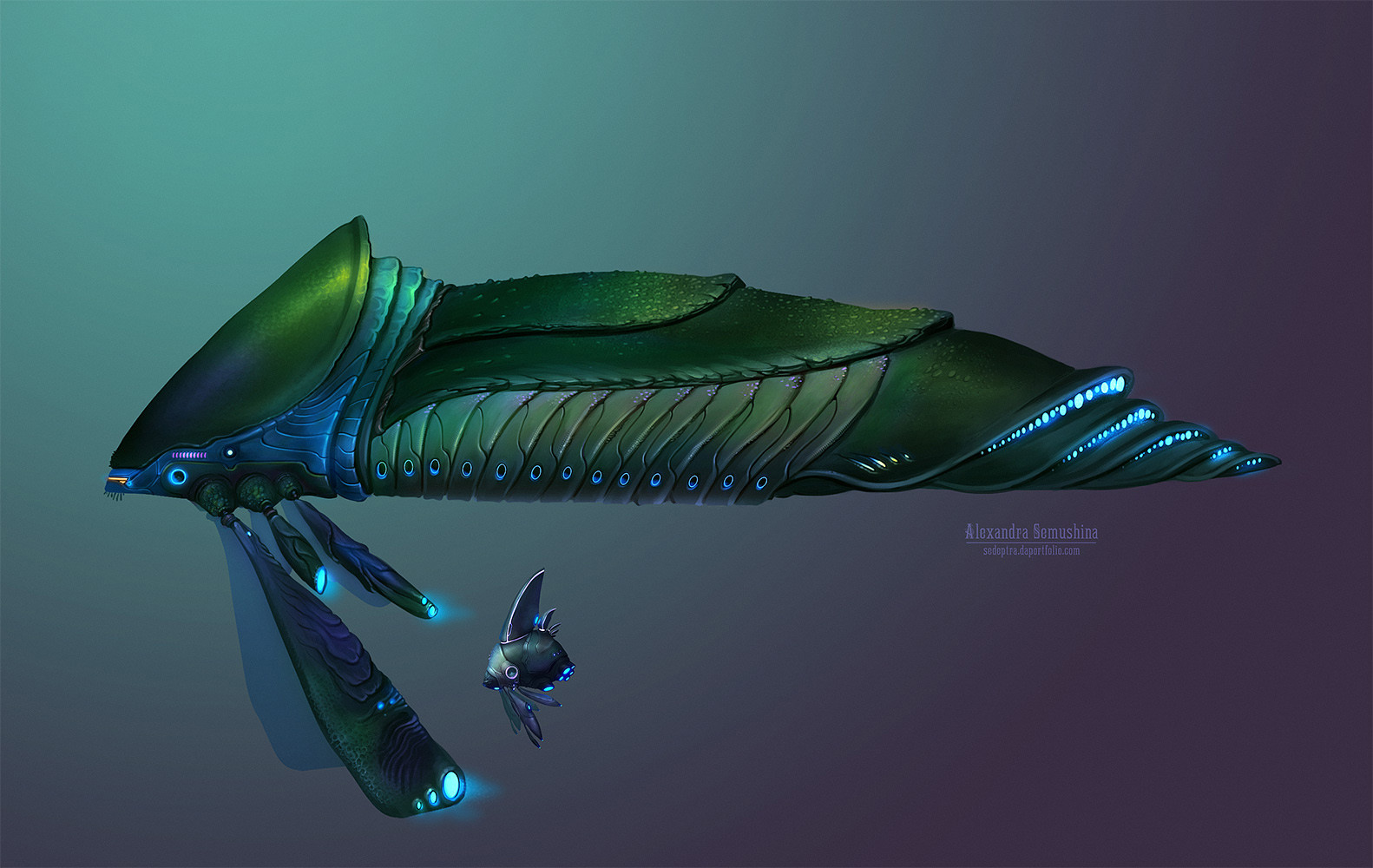
Alexandra Semushina

Graam

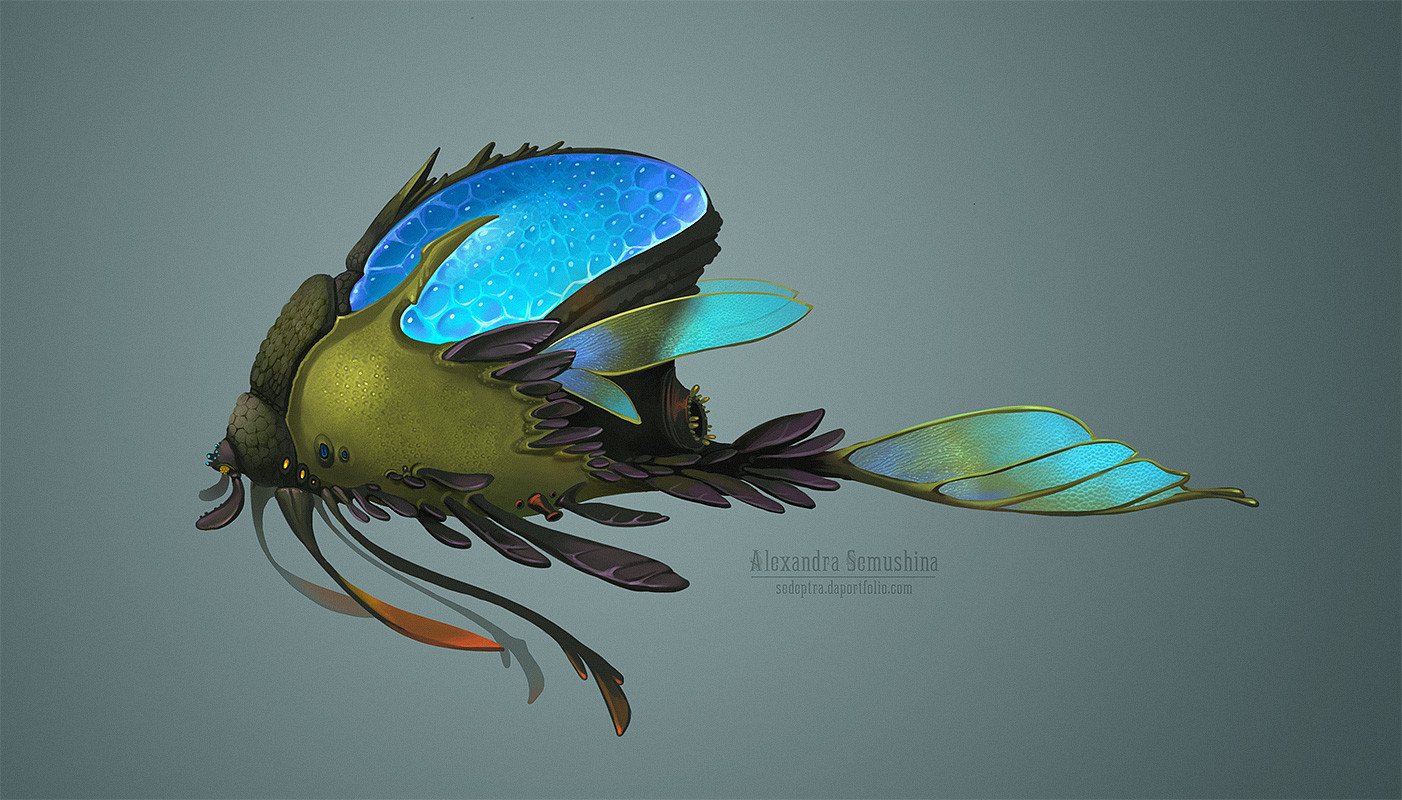
During the Collapse of the Spire, Graam was attacked with Shaped bioweapons by De Bahn. Since then, it has continued to be under martial law in an attempt to stop the spread of the plague.

In the decade after the Collapse of the Spire, many people left Graam: now the core of their territory is patrolled by Shaped monsters, both to keep people out and in.

The edges of Graam escaped the majority of the bombardment, and continue to act under the orders of their old government, sent through biotechnological radios.

Before the Collapse of the Spire, Graam was the most advanced of the nations: if someone could reach the poisoned core, they could return rich beyond measure.

Alexandra Semushina

De Bahn

De Bahn has been in decline since the Collapse of the Spire, with the treaties following it crushing De Bahn's industrial capacity and military strength. Like in Bös, religion in De Bahn states that the Wormgod will kill everything. However, according to De Bahn, this will not bring them to a new world: they will only die.

De Bahn's High King is searching for the pieces of the Spire in order to reassemble it. If he succeeds, it would lead to another war.

Alexandra Semushina

The Core

The Core is the area closest to the Wormgod, where none of the nation-states have control. Thanks to their proximity to the Wormgod, the people of the Core are able to export its scales to the three nation-states, where they are used in military Shapings.

Despite the lucrativeness of the Core, the lack of arable land and the difficulty of acquiring the scales persuades the nation-states to stay away from the region, and let the Core's people take on the risk of scale-mining.

Wormgod's Harvest Part 1

"And the worm consumed the world, and shed the Light by which we live."  

So, a quick sort of overview of Wormgod's Harvest, another setting because I don't have the attention span to finish anything. The Wormgod shattered the world in the Age Before, and is sleeping in the dead core. The mites from its skin fill the air, turning it faintly yellow. They're afraid of living things, but eat dead things.

Magic

Shaping (a type of constructive biomancy) is a large part of Wormgod's Harvest, along with Miteworking, the other magic system. Houses are usually either grown with Shaping or built out of stone, and travel between the sky islands (yes I'm using that trope) requires Shaped creatures.

Miteworking is the equivalent to religious magic: by praying against the Wormgod, you can intimidate the Mites into doing things for you. Unlike Shaping, Miteworking doesn't require long, drawn-out rituals, but the Mites don't stay afraid of you for very long.

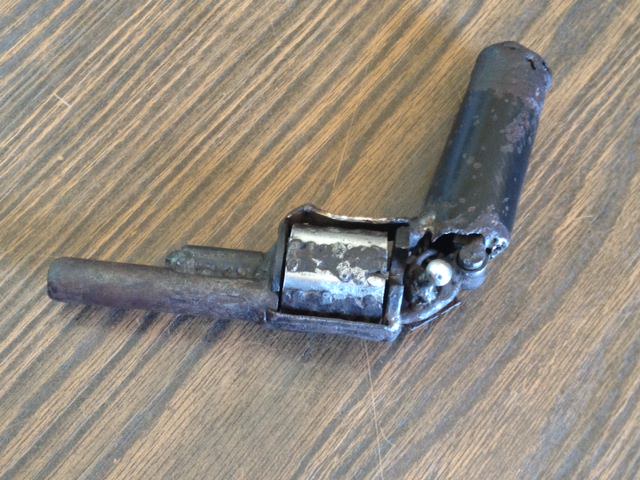
Related image 
This is heavily inspired by Scrap Princess's Another Gristly Campaign Skeleton.

Wednesday, March 27, 2019

Disciples of Keter

Disciples of Keter

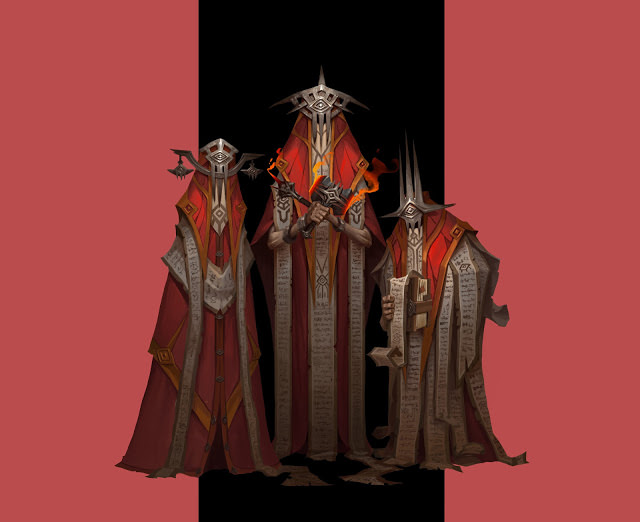
Infopriest

Infopriests are commanding figures in Keter's religion: they research scripture, speak to the androids below them, and lead pilgrimages across Ein Soph.

They hang text-laden banners off of themselves, and wear complex headdresses with Keter's symbols carved onto them.

Infopriest's Altars are made of androids welded together at the head: Infopriests ride them as they stagger to their destinations. To be a part of an Altar is a privilege granted only to the most pious.
Originally from Dungeon of Signs.

Stylite

Stylites are wandering philosophers, striding across Ein Soph on long, bladed legs. Geometric symbols stream across their faces as they speak in Enochian; Keter's artificial language, seeded with an uncountable variety of infohazards. More well-known Stylites are followed by fawning acolytes, recording their master's meditative ramblings.

In combat, Stylites are frail, but fast: unfolding their knife-like legs to stand above their foes and tear into them with constant attacks. Even while fighting, they continue their ravings; the infohazards in their speech burrowing into their opponent's minds as fighting continues.

Even a victory against a Stylite can leave horrible scars in the body and mind.

Manifestation

Manifestations are representations of Keter: holograms appearing as a tall flaming figure screaming warnings and threats. Around Manifestations, the ship appears to come alive - doors close as people walk through them, gravity turns and twists violently, and oxygen is ripped out of rooms.

Manifestations cannot be attacked directly: the projector creating it must be disabled.
Manifestations were originally a safety measure: Keter had to appear through them to warn people before he started directly controlling parts of the ship.

Tuesday, March 26, 2019

Engine Heart: Warbot Playbook

Engine Heart is a d10-based RPG where you play as small utility robots in a world where humanity is long gone. It can be downloaded for free here.
When I first heard of the game, I wondered what you were supposed to do with it. After reading through the 1d4chan page enough times, I figured it out. It's a game similar to O'er Windswept Golden Fields, where you don't just avoid violence for self-protection (like in most OSR games), but because it's the right thing to do. You can fight (the game has a combat system, and additions like buzzsaws and plasma cutters are options for your PC), but it's never necessary.

While this all sounds delightful (to me, at least), Engine Heart has a large problem for an OSR audience: its long, complex, point-buy character creation system.

None of us have time for that.

A solution for Engine Heart's chargen is Playbooks, similar to Beyond the Wall, where you choose a character concept and roll on a set of tables to create the character.

Engine Heart: Warbot


Who Built Your Processor? (1d4)

1. Hansa Automation - 3 RealityCom, 2 HumanCom, 2 DigiCon, 2 MechaniCon, 2 Buffer

2. Parable Intelligence - 1 RealityCom, 1 HumanCom, 4 DigiCon, 4 MechaniCon, 1 Buffer

3. Padlock Reinforced Processing - 2 RealityCom, 1 HumanCom, 1 DigiCon, 1 MechaniCon, 4 Buffer

4. ASQ Social Systems - 2 RealityCom, 4 HumanCom, 1 DigiCon, 1 MechaniCon, 1 Buffer


Who Built Your Chassis? (1d6)

1-2. Ducharme Optics - 2 Dexterity, 2 Mobility, 4 Perception, 2 Reflexes, 2 Strength

3-4. Yosef Industrial - 1 Dexterity, 1 Mobility, 2 Perception, 1 Reflexes, 5 Strength

5-6. EOM Advanced Motors - 3 Dexterity, 3 Mobility, 2 Perception, 3 Reflexes, 1 Strength


Major Feature (1d12)

1. Armored Chassis

2. Backup System

3. Battering Ram

4. Cutting Laser

5. Enhanced Cameras

6. Drill

7. Flight Ceiling

8. Hardened Programming

9. High Speed

10. Pneumatic

11. Self-Repairing

12. Secondary Battery


Minor Feature (Roll 1d10 Twice, Take Both)

1. Agile

2. Biofrequency Scanner


3. Collapsible

4. Loudspeaker

5. Magnetized

6. Silent Mode

7. Simple Assembly

8. Gyro

9. High Chassis

10. Floodlights


Defects (Roll 1d6 Twice, Take Both)

1. Compliant

2. High Maintenance

3. Lightweight

4. Major Overriding Directive

5. Rare Model

6. Power Cutoff

Friday, March 1, 2019

Infra-Red: Mechanical Nonsense

Due to its setting, Infra-Red's system moves quite far out from OSR orthodoxy.

It uses 6 stats: Athletics (ath), Driving (dri), Espionage (esp), Preparedness (pre), Shooting (sho), and Socializing (soc). Each skill starts as a 1, and characters have 6 points to assign between them, with a cap of 5 in a skill.

I use these stats instead of the traditional 6 because they focus more on what the PCs are assumed to be in Infra-Red: government investigators. I chose to use a point-buy system because there are a small enough amount of skills and points that this gives the player control without it being overwhelming.
For skill checks, you roll 1d6 and try to get equal to or below the skill being used.

Progression is inspired by Lost Pages' 1d6 Thieving: after failing a check with the skill 5 times, it goes up by one. If the skill is above 5, you roll multiple checks at once.

For example, a skill of 7 means you roll 2 dice, one against 5 and one against 2. if either die succeeds, you succeed.


Thursday, February 28, 2019

Silver Swords Has 48 Hours Left!

I wrote an elongated version of A Positively Monstrous Way of Thinking for the Silver Swords zine, which you can back here! (It's $1 away from its stretch goal, too!)

It also has stuff from Follow Me And Die!, Papers & Pencils, and plenty of other OSR word-people.

Friday, February 22, 2019

Pendragon of Mars Character Creation

Pendragon's character creation can be best described as insufferable. I mean really; if your book has a heading that says "Allot Prime and Derived Statistics", it should be aimed at accountants. To help with this, I took everyone's favorite page from everyone's favorite book to take pages from: DCC's funnel.

To begin a game of PoM, you create 4 simplified Pendragon characters, each of which has 5 stats: Size, Dexterity, Strength, Constitution, and Appearance. For each stat, roll either 4d6 drop lowest or 3d6, depending on how authentic/masochistic you feel today.

Each character's HP is equal to their Constitution + Size, and they all do (SIZ+STR)/6 d6 damage with a melee attack. Your character drops unconscious if they reach 1/4 of their total HP.

Next, the characters create mechs. For the funnel, they choose a mech model:

Ballista
A long-range artillery mech, able to hit targets at the longest ranges of any mech. However, it is slow and lightly armored, and can be easily defeated by swarms of enemies.

HP: 65
Armor: 4
Move: 2

Components
Light Field Gun: 6d6 damage, no line of sight required, roll under 15 to hit
Long-range Comms
Active Sensors
4 Smoke Grenades

Stalker
A small scout mech, with light armaments but lots of passive components.
HP: 45
Armor: 0
Move: 4

Components
Light Laser: 2d6 damage, roll under 12 to hit
Silenced Servomotors
Active Sensors
Camouflage Paint
Short-Range Comms

Paladin
Paladins are frontline combat mechs, with heavy armor and weapons. However, they have a very short range. 
HP: 80
Armor: 4
Move: 2

Components
Rocket Pods: 2 shots at 2d6 AoE damage each, 1d4 usage dice
Medium Laser: 3d6 damage
Passive Sensors
Short-Range Comms

After The Funnel

Once the funnel is complete, players choose one of their surviving PCs to become a knight of 1st level: at 1st level, PCs get skills.

Skills are divided based off of what stat they use. The PCs score in that stat is now the pool of points for those skills.

For example, if a PC has a 12 in Bad Acting, they can put 5 points into Scenery-Chewing, 3 points into Mechanical Intonation, and 4 points into Literally Holding Your Script In Front Of Your Face.

As well as this, you can start to customize your mech with different components and weapons.

The Forest of Towers & The Coolant Sea

The Forest of Towers

The Forest of Towers is where the majority of Ein Soph's ecosystem lives. Intended to be the ship's hydroponics bays, the water eventually overflowed (as Keter no longer needed to take the time to focus on it), eroding through the floor. And then again. And then again. And then... you get the idea.

Now, the more reinforced parts of the hydroponics bays survive in tall, plant-choked towers above the Coolant Sea.

Inhabitants of the Forest of Towers

https://arthurevans.files.wordpress.com/2010/03/img_1012.jpg
The Symphlan's threads can cause heart failure if driven far enough into the skin.
The Forest is the most densely populated environment of Ein Soph: large feathered crickets, poisonous threaded symphlans, and other creatures fill the pillars, along with Keter's looming Stylites and ancient food-production robots.
https://www.startupticker.ch/uploads/Image/Articles/ecoRobotix3.jpg
Pesticides can be equally effective against human targets.

The Coolant Sea

The Coolant Sea lies beneath the Forest of Towers, where radioactive reactor runoff mixes with water from the hydroponics labs. Crossing it is made difficult by the mangrove-like trees growing into it. Predatory water striders skim over the surface, capsizing boats. Far beneath is the Hydra, a gigantic crustacean with hundreds of lamprey-like heads.

Wednesday, February 20, 2019

Sunless Horizon: The Empyrean

A perfect dystopia. A heaven with no exits, and ten thousand eyes trained on you.
The playground of a mad God.

The Empyrean is the core of Ein Soph, where Keter holds the last of humanity in a 20-mile long cylinder. Those people, known as the Chosen (or His as a pejorative), worship Keter as a god, through his Prophetess Maia.

Every day, Keter's temple blares infohazards into the sky, summoning his flock to worship.
WORSHIP
REPENT
The people of the Empyrean are ceremonially implanted with a nerve staple when they are born. The nerve staple is a small device inserted into the spine at the back of the neck.

If one of the Chosen are found to be subversive, the nerve staple is activated, sending its own signals down the spine. The rebel walks out of the cylinder, and kills themselves as a copy is printed in Keter's biotech bays.

The Empyrean also has its own police under the control of the Prophetess, to handle other crimes.

In case of a widespread rebellion, the temple's infohazards change into more destructive commands.

BOW DOWN
After the rebellion is contained, Keter switches to damage control infohazards, removing the public memory of his actions.
FORGET
None of the Navigator Houses have managed to get deep enough into the ship to find the Empyrean, and no one has ever escaped it. Yet.

Monday, February 18, 2019

Sunless Horizon

Sunless Horizon is the most self-indulgent setting I'll ever make, taking inspiration from Veins of the Earth, Axis Mundi, HMS Apollyon, Rain World, Orion's Arm, and Duskers.

The stars are dead. As the universe collapsed, humanity built Ein Soph: a worldship controlled by a network of AIs intended to keep operating until the AIs could find a way to dig into a new universe.

That was thousands of years ago.

The AIs have all been subsumed by Keter, who sealed the last of humanity into the Empyrean: a 20-mile long O'Neill's Cylinder under his direct supervision, "ruled" by the Prophetess Maia.


Outside of the Empyrean, castoff biotech projects have grown into their own species, laboring under the feudalistic Navigator Houses, who say they control Ein Soph, and that they're headed to Heaven.

Keter's protective programming extends only to humans, not to his creations: his androids tear at the borders of the Navigator Houses as he gets ever closer to pulling open reality.
Keter's Infopriests lead pilgrimages across the Coolant Sea atop their walking altars.
Rumors abound of the unnatural technologies Keter can bring to bear: Tipler Oracles, memetic plagues, non-euclidean creatures, and nanobot swarms.


Outside of Ein Soph, the universe is dark. The stars have all burned out. However, fragments of Ein Soph's supporting fleet orbit around the worldship in a halo-shaped mass called the Crown. Expeditions by the Navigator Houses have never returned, but that doesn't stop whispered discussion of what could live there. Some say the Crown is Keter's final defense, preventing any escape from Ein Soph.
The weapons of the peasants are crude and ineffective.
The Navigator Houses send missions out into Ein Soph to gather resources: these expeditions cross paths with Ghoul Nests, Keter's Disciples, and the creatures that have evolved to live in this hellish, lightless environment.
The Disciples scrawl strange symbols on their travels. Some can kill.

Tuesday, February 12, 2019

Anthology Campaigns

Everyone wants to run a long campaign, but short campaigns have their advantages: being able to actually finish, the ability to run multiple campaigns in different settings more quickly, and ease of planning.

However, one of the most difficult things to do with a short campaign is to explore a setting. With only 10 sessions (for example) your players will be going from A to B to C, with no time for taking a long trip to the next continent over and learning about the Thousand Eternal Emperors.

A possible (albeit untested) solution for this is what I call anthology campaigns: a branching set of one-shots where the player's performance in one effects the others.

For example, a short anthology campaign for Infra-Red could look like this:

Monday, February 11, 2019

Pendragon of Mars Monsters & Races

Pendragon of Mars was a seven session campaign run by Monsters and Manuals all the way back in 2013 (I know it wasn't that long ago but I wouldn't know what an RPG was if you concussed me with one in 2013). For some reason, I found the concept (feudal mech-knights on Mars) weirdly enthralling, despite its silliness.

So I planned to start running it (with a combination of a boiled-down Pendragon and ICRPG fan-made mech hack), before realizing I had no monsters.

I don't know how useful this post will be (with stats given for Pendragon instead of any conventional OSR systems) but it'll become more helpful if/when I release a polished-up Pendragon of Mars hack.

Monsters of Mars

Geteit Chemosit
Geteit Chemosit are cylindrical, 4-legged automata wandering the deserts of Mars, attacking people and stealing their brains to bring back to their masters. There are two types: the oldest Geiteit Chemosit were made of a durable green ceramic before the apocalypse, while the more recent are made of red stone by the Martians.

All Geteit Chemosit are controlled by the brains they steal from the people they attack.

Some scouts have sent reports of Heitet Chemosit: they tower over even the largest Geteit.

noisms stole it first
HP: 60
Unconscious: 15
Armor: 8

SIZ: 18 (215 lbs)
DEX: 4
STR: 18
CON: 13

Move: 2
Healing Rate: 0
Damage: 6d6

Combat Skills: Crush 13
Skills: Avoidance 2

Decapitate: If a character is Unconscious next to the Geteit Chemosit, it can spend its action sawing through the character's head and removing its brain, instantly killing the character.

Modrons
Modrons were a pre-apocalypse plan for terraforming Mars. Since the apocalypse, they've spent their time excavating and building in random places. They all come from the northern Modron's Wilderness: a landscape edited into a forest of perfectly geometric stones and tall pillars.


JESUS CHRIST I HAD NO IDEA THESE WERE SO CREEPY
HP: 10
Unconscious: 2
Armor: 2

SIZ: 1 (10 lbs)
DEX: 14
STR: 3
CON: 5

Move: 5
Healing Rate: 0
Damage: 1d6

Combat Skills: Claw 11
Skills: Avoidance 12, Industry 20

Sandworms
https://kitchenoverlord.com/wp-content/uploads/2015/12/sandworm-bread-03.jpg
Sadly they do not come as cakes.
The deserts of Mars are patrolled by giant sandworms with mouths the size of houses.

Making loud noises does not attract sandworms: in fact, it intimidates them and forces them away.

HP: 100
Unconscious: 25

Armor:

SIZ: 55 (2 tons)
DEX: 2
STR: 20
CON: 18

Move: 7
Healing Rate: 5
Damage: 10d6

Combat Skills: Bite 19
Skills: None

Races of Mars

The Pale
The Pale are whip-thin and up to 10 feet tall; their heads are hollow toruses, with a reflective black dot floating in the center. They have no eyes or mouths.

According to folklore, the Pale are the ghosts of the dead ancients: the Crowned Ones who colonized Mars and built the mechs that are still passed down. The Pale support these rumors; it makes people leave them alone.

Martians
Martians are mole-like bipeds with a stark red coat. They are nearly blind, seeing with a tendril-covered nose.

They live below the surface of Mars, where their mine-cities stretch for hundreds of miles.

The Martian nations are careful to keep relations between each other jovial: a care they stretch to the human kings as well.


Xosna
Xosna are small, weak things with a single, 3-pupilled eye. They are on a crusade to bring their religion (and the advancements of their society) to the rest of the world. To the human kingdoms, they are a plague that constantly pushes its borders.

The Xosna are organized into a caste system of queens, workers, and praetors, who are the vast majority in the Xosna crusade. Praetors are sealed into their mechs for life.

If there are other Xosna nations, they have not been heard from. Perhaps they support this crusade as well.

Saturday, January 26, 2019

1 Year Anniversary Gift to You!

I can't believe anyone's still with me after a year of this nonsense.
To celebrate, I give you Artificial Sky: a completed cyberpunk GLOG/Shadow of the Demon Lord hack.

Artificial Sky


Friday, December 28, 2018

Infra-Red Part 2: The United States


THE UNITED STATES


GOVERNMENT

THE UNITED STATES IS CURRENTLY RUN BY JOHN F. KENNEDY, A DEMOCRAT. FOREIGN RELATIONS HAVE WORSENED SINCE THE TAKEOVER OF BRAZIL, LEAVING THE UNITED STATES ALONE AGAINST ITS MANY ENEMIES.

MILITARY

THE AMERICAN MILITARY IS CENTERED IN WASHINGTON, D.C AND FACILITY 1, BUT THEY ARE BEGINNING TO TEST CONTROLLED INFRALS IN VIETNAM AND BRAZIL.
THE ICRA IS GENERALLY REGARDED AS PART OF THE MILITARY, BUT IS GENERALLY USED IN DOMESTIC ACTIONS IN THE UNITED STATES AND BRAZIL. THE ICRA DOES NOT HAVE ACCESS TO MILITARY EQUIPMENT, BUT ARE USUALLY GRANTED INFRALS DURING OPERATIONS IN BRAZIL. THEY ENJOY AN UNUSUAL DEGREE OF FREEDOM: ICRA ASSET COLLECTION TEAMS TASKED WITH RECOVERING INFRALS ARE GIVEN ALMOST COMPLETE AUTONOMY AS LONG AS THEY FOLLOW THEIR MISSION'S OBJECTIVES AND MINIMIZE CASUALTIES.

LIFE IN THE US

THE UNITED STATES HAS BECOME MORE AND MORE DIVIDED SINCE THE TAKEOVER OF BRAZIL. CIVIL RIGHTS MOVEMENTS HAVE ABSORBED DISPLACED BRAZILIANS, INCLUDING MEMBERS OF THE MNB, OR MOVIMENTO NACIONALISTA BRASILEIRO: A VIOLENT BRAZILIAN NATIONALIST GROUP.
AS MNB MEMBERS PUSH CIVIL RIGHTS MOVEMENTS INTO EXTREMISM AND VIOLENCE, THE AMERICAN GOVERNMENT RESPONDS IN KIND WITH SWEEPING POLICE MILITARIZATION INITIATIVES.
OUTSIDE OF THE CIVIL RIGHTS MOVEMENT, LIFE CONTINUES AS NORMAL: THE ICRA HAS SUCCESSFULLY HIDDEN INFRALS FROM THE GENERAL POPULACE, FEARING THAT THE DISCOVERY OF ALIEN LIFE WOULD CATAPULT SOCIETY THE REST OF THE WAY INTO COMPLETE CHAOS.


CURRENT EVENTS

1. PROJECT HIGHRISE HAS MADE IT'S FIRST BIG BREAKTHROUGH, HAVING DISCOVERED HOW TO CONTROL INFRALS: ELECTRIC SIGNALS DIRECTLY TO THE "BRAIN" USING METAL NEEDLES CONNECTED TO BATTERIES.

2. SOME MEMBERS OF THE GOVERNMENT THINK INFRALS MIGHT BE NEEDED TO QUELL RIOTS

3. MNB MEMBERS ARE PLANNING AN ATTACK ON A FACILITY IN THE AMERICAN SOUTHWEST

4. ICRA ASSET COLLECTION TEAMS SUSPECT A GROUP UNAFFILIATED WITH THE MNB TO BE HOLDING INFRALS IN A WAREHOUSE IN NEW YORK

Thursday, December 13, 2018

A Positively Monstrous Way of Thinking

heh, puns

Back in 2010, noisms posted a piece on fighting large groups vs. single large enemies. In his experience, D&D is often paired with the first method, where encounters are against groups of monsters, with single foes only appearing as rare boss fights.

I'm more interested in the second approach, which he titles "Giant Slaying": rare encounters with large, threatening, and unique single enemies. In my opinion, this could be expanded even further into a monster of the week style game, where entire adventures are built around a single monster.

Each of these adventures are split into two portions: the chase and the kill. For some monsters, the chase is the hard part, while others are easy to find, but difficult to kill.

For example, I used the Forge to create 4 monster names: Soul Halcyon, Pale Antler Dragon, Needler Heart, and the Lotus Beak Wyrm.

All of these are meant to be difficult fights for 1st or 2nd level parties, so stat accordingly.

Soul Halcyon
The Soul Halcyon is an infection as much as it is a monster. It spreads between people, connecting a hyper-empathic hivemind: the infected are so nice they'll point you towards the Soul Halcyon itself: the problem is catching up to it.

The Chase: The Soul Halcyon's physical form is fast, but the hive will point you straight to it. The Soul Halcyon will seek large population centers to infect.

The Kill: The Soul Halcyon's speed continues to reward it in combat: it's twice as fast as a man, and can fly short distances. Along with melee attacks, its scream forces WIS saves to resist inclusion into the hivemind (treat as a Dominate Person spell).

Pale Antler Dragon
The Pale Antler Dragon doesn't fit in the forests it lives in: it only feels comfortable when its wide spines scrape against the trees.

Image result for dragon with antlers 
The Chase: The Pale Antler Dragon shifts through the densest parts of trees, constantly scraping as it moves. Its cowardly nature leads to its use of simple traps and diversions: creating decoys to lead the party under a falling log, for instance.

The Kill: Getting the Pale Antler Dragon into a straight fight mandates trickery and traps to stop it from barreling over a tree and vanishing into the forest. When finally cornered, the Pale Antler Dragon is a violent melee combatant, throwing PCs across the forest with wide sweeps of its horns and crushing them with its claws.

Needler Heart 
The Needler Heart is an immobile construct buried underground, slowly infecting the earth with spiked tunnels and fractal pathways.

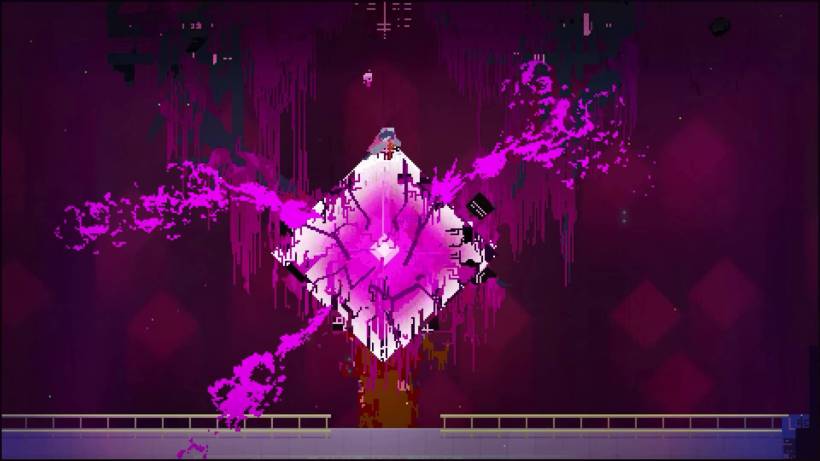
Image result for hyper light drifter immortal cellThe Chase: Navigating the maze-like passages around the Heart takes time as they shift around you: every round there's a 1-in-6 chance they flail wildly, requiring DEX checks to avoid the waving spikes.

The Kill: The Needler Heart is immobile but surrounded by writhing spikes: cutting them off is easy, but they attack you freely as long as you're in range. The Heart can grow spikes from the floor to effectively remove parts of the terrain, or attack directly by extending a massive needle.


Lotus Beak Wyrm
The Lotus Beak Wyrm's scales flake off constantly, creating a hallucinogenic haze around it, that remains as it moves through the mountains its made home.

The Chase: Following the Lotus Beak Wyrm directly only gets the PCs more lost as the hallucinogens set in.

The Kill: The Wyrm is very lightly armored, but the combination of the waving fronds on its body and the hallucinations create a very unpleasant environment to fight. The hallucinogens are deactivated by water: shoving the Wyrm into a lake or stream will make it far easier to kill or capture.

Friday, November 30, 2018

"Scientific" Random Monster Generator (With Examples!)

After reading some of Throne of Salt's mini-bestiary entries, I decided to make some of my own from prefixes and suffixes used to give animals their scientific names. At some point that turned into using Meandering Banter's HTML table creator to make an auto-rolling table of all the prefixes and suffixes I could find on Wikipedia.

Click below to get a name and tiny description.


This isn't intended to be used at the table, just to make something interesting.

NOW IT IS TIME FOR EXAMPLES

Deinopelta (Terrible Shield)

"An awful weight, a horrible speed. But only forwards. To retreat is to die." 
Their dozen-legged children hold on to the bulls as they crash through the trees. No one has ever seen one walk backwards.

Stegoornis (Roof Bird)

"A wandering sunset. Hide from the shade."
The Stegoornis' wide wings are used to blot out the sun above their targets, blinding and confusing them before the strike.

Brontonax (Thunder King)

"Lightning does not kill. It only carries."
A sky-romantic, dragged above in return for their prayers. Too far gone to speak with, but to distracted by their love to attack.


Saturday, November 3, 2018

A Severe Lack of Creativity (But Also 3 New GLOG Classes)

You all know about D&DWiki, right? Home of strange, unbalanced homebrew in absurd amounts?

I've got a strange nostalgia for the place: it was where I first learned you can make new things for RPGs.

However, most of the classes, items, and monsters can be of... variable quality. And given that they have 1031 CLASSES FOR 5TH EDITION (oh my), most people don't want to look through all of them. Because there's a lot of them.

So, I decided (thanks to a staggering lack of creativity after working on Infra-Red and Sunless Horizon) that I want to bring some of them into the light of the OSR.

All of these classes are in the GLOG format, and have links to the originals.

Sacrae

The Sacrae are bound to the Wheel: a world-connecting energy: they manipulate the Wheel's connection to their opponents to effect them.

By https://www.deviantart.com/anotherwanderer

A: Veni

B: Caeci
C: Spero
D: Terra

A: Veni
As an action, target an opponent: they must make a Charisma save or their Wheel bends, unbalancing their body in return: they lose -2 AC. The Sacrae regains use of this ability once per long rest.

B: Caeci
Once per long rest, the Sacrae slightly tears the top of the target's Wheel: they must make a Charisma save or be blinded for one round.

C: Spero
Once per long rest, the Sacrae mends the target's Wheel, removing any effects (such as poison), and restoring 2d4 HP.

D: Morta
Once per long rest, the Sacrae shatters the target's Wheel, damaging themselves in the process. The target must make a Charisma save or take 3d8 damage: the Sacrae takes half of that damage.

Fencer

The Fencer is a melee glass cannon: it's able to do way more damage than seems reasonable, but a single good hit could get him rolling on your favorite Death & Dismemberment table.

The Fencer rolls 1d4 instead of 1d6 when generating HP.

Face net not mandatory.


A: Improved Critical
B: Challenge, +1 Critical Margin
C: Bleed Out, +1 Critical Margin
D: Nimble Strike, +1 Critical Margin

A: Improved Critical
The Fencer's experience makes it easier for them to accurately strike: they Critical Hit on rolls of 19 or 20, decreasing with each Fencer template. (On Template D, a Fencer would Critical Hit on rolls above 16.)


B: Challenge
The Fencer can challenge opponents to duels: in combat, the target must Save or be goaded by his calls. Outside of combat, nobles, knights, bandits, mercenaries, and similar will begin combat: if the Fencer wins, he gains +3 to Charisma when persuading the duel's audience.


C: Bleed Out
Successful attacks by the Fencer deal 1d4 CON damage as well as their normal damage.

D: Nimble Strike
When using a one-handed weapon, the Fencer can make 2+DEX mod attacks per round.

Daemon Eater

The Daemon Eaters are an order of paladins that bind daemons into their own bodies: a pious body makes the greatest cage for a creature of hell. As the daemons grow, they warp the Daemon Eater's form.

By https://www.deviantart.com/aditya777


A: Malevolent Form
B: Daemonic Art
C: Growing Corruption
D: Spreading Malevolence   

A: Malevolent Form

The daemon within you has corrupted one of your body parts. Choose one or roll 1d4 to decide which.

Arm
One of your arms is no longer your own. It's covered in a shifting set of armored scales, and ends in a set of long talons. You do 1d4 damage with your unarmed attacks, and can make an immediate grapple check if you hit. Your STR increases by 2.

Leg
Your movement speed increases by 10 ft, and your DEX increases by 2.

Eye
Your eyes fill with fire. You can see normally in darkness up to a distance of 60 feet. Your WIS increases by 2.

Heart
Your heart pumps black oil through your body. You gain +2 on all Checks and Saves caused by poisons. Your CON increases by 2.

B: Daemonic Art

Arm
Once per short rest, the scales on your arm shift into a pointed tip as you make an unarmed attack, dealing 2d4 damage.


Leg
Once per short rest, you can either make a leaping attack dealing 1d4 damage and flinging the target backwards.

Eye
Once per short rest, you can target someone who then must make a Wisdom save. On a failure, they are charmed for 1d6 minutes.

Heart 
Once per short rest, your blood begins to boil, returning 1d6 health instantly.


C: Growing Corruption 
The daemon's influence over your body increases. You gain a new bonus based off your which body part was corrupted.

Arm
Your arm's talons grow, and start to drip a burning venom. Unarmed attacks deal 1d4 damage and the target must save or take 1d4 damage from poison.


Leg
You can anchor yourself on vertical surfaces and ceilings, although your movement speed decreases by 20 ft while on them.

Eye
The fire brightens, giving you +2 to hit with ranged weapons.

Heart
Your blood hardens, giving you +1 natural AC. 

D: Spreading Malevolence  

You can either choose or roll for one additional limb, which gives you the benefit of that limb's Malevolent Form.

Monday, October 29, 2018

Infra-Red: Memories of the Past

The Wound opened in late 1952, in a rural portion of Brazil. after nearly decade of unproven stories of strange, crystalline creatures wandering through Brazilian towns, the Brazilian government announced an incredible discovery: a gap in reality, named The Wound, that the creatures had been coming out of.

Image courtesy of Scrap Princess, who is better than me in every way.
In the space of a month, war broke out in Brazil as the United States invaded, planning to take control of The Wound. As the war continued, sanctions mounted against the U.S., with much of Europe cutting trade off completely.

After the Brazilian takeover ended, the American government built Facility 1: a titanic complex of reinforced concrete atop The Wound. 

The creatures emerging from The Wound - known as Infrals - were captured and John F. Kennedy created the ICRA (Infral Containment and Research Agency) and Project Highrise to find a way to use Infrals as weapons and stop opposing nations from acquiring them.

Friday, October 12, 2018

The City of Gateway, Part 1

Gateway is part of Age of the Ecclesiarchy, an abandoned setting where the ur-god, Ilephoth, looms above the world, wearing the sun as a crown. The world is (mostly) ruled by the Ecclesiarchy: worshippers of Ilephoth, Archon Above Heaven, He Who Struck Down the Hateful Moon.


The city of Gateway is placed just on the edge of the Desolation, where the Ecclesiarchy's territory ends. Gateway is so far from the capital that the Divine Legion can't reach it without months of marching, meaning it's left almost entirely alone (as well as being almost the only place you'll see an elf).

Major Figures of Gateway

The most important person in Gateway depends on who you ask. If you ask a loyal Ecclesiarchist, they'll say Governor Tiberius, a weak-willed pitiful man terrified that Gateway is slipping out of his control.

If you ask anyone else, they'll probably say Sashiseth Iazelmei, one of the 4 prospective leaders of the Hand of Acor, a criminal organization/rebellion/cult. The last leader, Solana Aelrue, died in the Rain of Embers, where the Divine Legion burned down half the city in a demonstration of force. If anything, the Rain of Embers made the problem worse: the death of Solana lead the rest of the Hand to collapse into infighting as Solana's officers made a grab for power after her death.

As unstable as it is, the
Hand of Acor is the government in Gateway, as far as the people are concerned: the Watch spends most of its time being manipulated by Commander Acosta as she tries to climb the ranks of the Ecclesiarchy, leaving Sashiseth's private security the job of keeping the town from sliding the rest of the way into anarchy.


The other three prospects for leader are less well-respected. One, an illiterate ogre Solana kept as an enforcer, took the name Tagnor Bonecrusher after being told people would find it intimidating. (Most people just laugh.) Elissa Grove, one of the Hand's spies, wants to be leader, but she knows her followers couldn't win in a straight fight against Sashiseth or Tagnor's.


Imbril Arasys is the last candidate, and one of the few magic-users in the Ecclesiarchy to have escaped conscription into the Divine Legion. In Solana's time, he trained her wizards for use in the Hand. Since the Rain of Embers, he's dug a 5-story basement into an abandoned home, where it is said he works with the Lich Queen Amara Naumys to overthrow the Ecclesiarchy: a cause he wants to turn the Hand to.

Saturday, October 6, 2018

Hack & Slash (No, Not the Blog)

If you're here because of the link on the cover, welcome! Hack & Slash is far from the pinnacle of RPGs (trust me), but you can add to it easily: if you want a new mechanic (a chance to miss attacks, overland travel, or rules for ranged weapons, perhaps?), new weapons, new monsters, and especially new adventures, MAKE THEM. If you want to tear the entire thing apart and write your own, do that!

But one thing: if you do add something to the game, tell me about it! Send new rules, enemies, and whatever else you come up with to archonscourtgames@gmail.com

For everybody else:

Hack & Slash is incredibly simple: it's a classless 2d6 system without AC or experience, and a basically handwaved equipment system, intended to bring RPGs to more people as simply as possible. The entire game is 6 pages long (7 if you include the cover.)

Isn't it adorable?

I plan to expand on the system with Total Hack & Slash as well as Between the Stars, a sci-fi version, both in a very short format.

You can get the pdf for Hack & Slash here.

Sunless Horizon Beta 2.3 Release

Commissioned from Scrap Princess excited screeching I've been posting about  Sunless Horizon  for about a year, and after finally gettin...